Fort area in south of Bombay, now Mumbai, lays out an array of Victorian Architectural examples building after building. A legacy from our colonial history, its a good anti-thesis to all that this city has grown to stand for over the years. Much like your average Bombayite, yours truly, had no clue about the history or the reasons-to-be of this building, apart from the knowledge that it was recently restored by the KalaGhoda Association. But devotion to eyecandy and a flickr induced photography obsession made sure I captured Elphinston College and wrote about it here.

 "Finely articulated stone balconies, brackets and balustrades along with intricately designed surface motifs add to the decorative features of the building. With an imposing facade and skyline, it is among the select list of Grade I Heritage buildings in the city, meriting careful restoration and preservation of its historic fabric. " For more history and information click here
 "This majestic building was designed by Trubshaw and Khan Bahadur Muncherjee Murzban in the 1880's. Originally meant to house the Government Central Press, it was completed by John Adams, Executive Engineer to the Bombay Government at a total cost of Rs 7,50,000 (Rupees seven and a half lakhs) which included a substantial sum donated by Sir Cowasjee Jehangir. The building was used for academic activities from April 1888. "
 "The College building has been nominated for UNESCO's Asia-Pacific Heritage Awards for Culture Heritage Conservation for the year 2004."
"The rich library of the college has a collection of over one lakh books, journals and periodicals. Its range is vast - from some of the oldest and rarest books in the country to the latest and the contemporary."

A passage which is sealed off so that it doesn't become thoroughfare.
 The details- which make all the reasons-to-be secondary.
A thing of beauty is a joy forever.
 "
"


 Art in the bedroom.


 "IIM-A was established in 1961 as an autonomous institution by the Government of India in collaboration with the Government of Gujarat and the Indian Industry. In its formative years, it collaborated with the Harvard Business School. Largely as a consequence of this collaboration, IIM-A pioneered the case method of teaching in India. And since then, it has remained the last word in management education in the country."
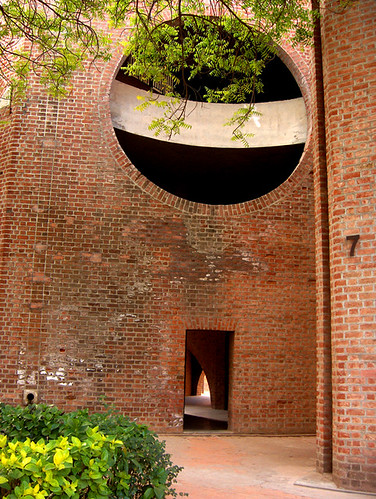
 "Designed by


 "Kahn's architecture is notable for its simple, platonic forms and compositions. Kahn design of buildings, characterized by powerful, massive forms, made him one of the most discussed architects to emerge after World War II. Through the use of brick and poured-in place concrete masonry, he developed a contemporary and monumental architecture that maintained sympathy for the site. While rooted in the International Style, Kahn's architecture was a blend of his Beaux Arts education and a personal aesthetic impulse to develop his own architectural forms"

 Posts
Posts